Why Am I Seeing Mushrooms All of a Sudden on My Tree?
Mushrooms on or around a tree usually mean a fungus is decaying wood. An arborist explains which ones to worry about, which are harmless, and what to do.
 By Adam O'Connor, ISA Certified Arborist
8 minutes read
On this page
Every fall I get the same questions and likewise I see the same posts on social media. Someone walks out after a week of rain and finds a ring of mushrooms around their oak, or a big shelf growing out of the trunk, and wants to know if the tree is about to fall on the house.
Sometimes the answer is “no, that’s fine.” Sometimes it’s “let’s take a closer look.” Where the mushroom is growing tells you most of what you need to know.
The mushroom isn’t new, even if it looks it
A mushroom is the fruit of a fungus. The fungus itself is a network of fine threads called mycelium and lives in the soil or inside the wood, and it has usually been there for years before it fruits. It sends up mushrooms when conditions suit it: warm soil, a run of wet weather, the cooler nights of late summer and fall.
So when mushrooms seem to appear overnight, nothing new has happened to your tree. You’re just seeing, for the first time, something that was already there.
Some of these fungi are partners. Many trees live with fungi on their roots that help them take up water and nutrients. Others feed on dead wood. When that dead wood is a buried root or the inside of a living trunk, the fungus is causing decay.
Where it’s growing matters most
In the lawn, a few feet or more from the trunk. These are usually feeding on buried organic matter: old roots, a stump that was ground years ago, construction lumber, thatch. Some are the root partners I mentioned. On their own, mushrooms out in the lawn are rarely a sign the tree is in trouble.
At the base of the trunk or on the root flare. This is the one to pay attention to. Mushrooms growing right where the trunk meets the ground, or on the roots spreading out from it, often mean root rot or butt rot. That’s decay in the wood that holds the tree up. A tree can look green and healthy on top while its anchoring roots are being eaten away.
On the trunk or a branch, higher up. A fungus fruiting from the trunk is decaying wood inside it, often entering through an old wound, a pruning cut or a crack. The question is how much sound wood is left around the decay.
On a dead branch or an old stump. That’s the fungus doing its normal job of recycling dead wood. It’s worth removing a dead branch over a place people use, but the mushroom itself isn’t the problem.
A few common ones
These are fungi I’d want an arborist to look at if they turned up at the base or on the trunk of a tree near your house, driveway or play area. I’m describing them so you know what you might be looking at, not so you can diagnose your tree from a photo.
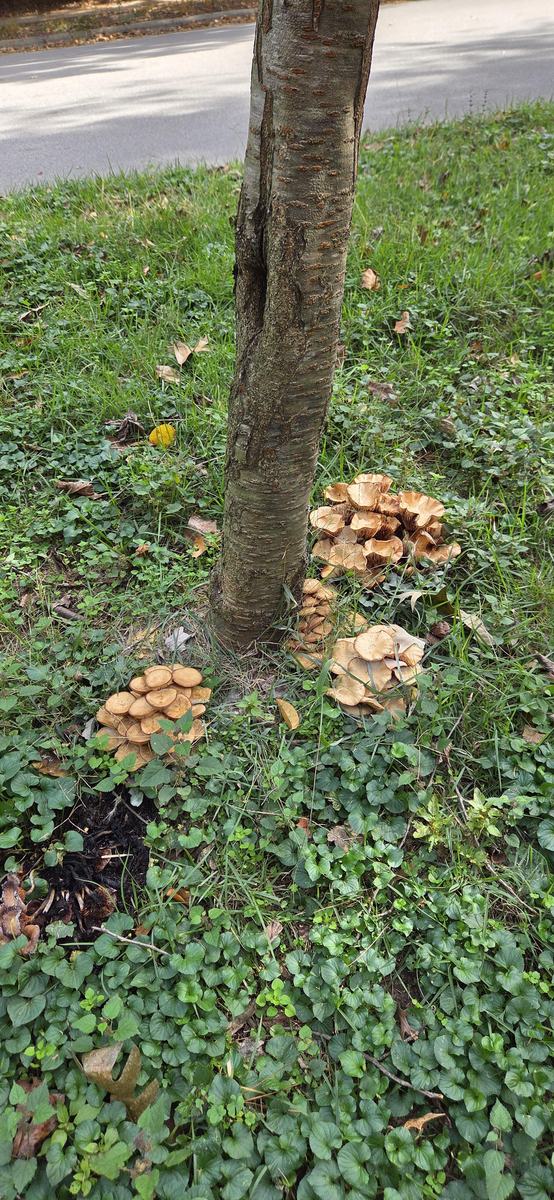
Honey mushrooms. Clusters of honey-coloured to tan mushrooms at the base of the tree or over the roots, usually in fall. They cause one of the most common root rots in trees and shrubs.
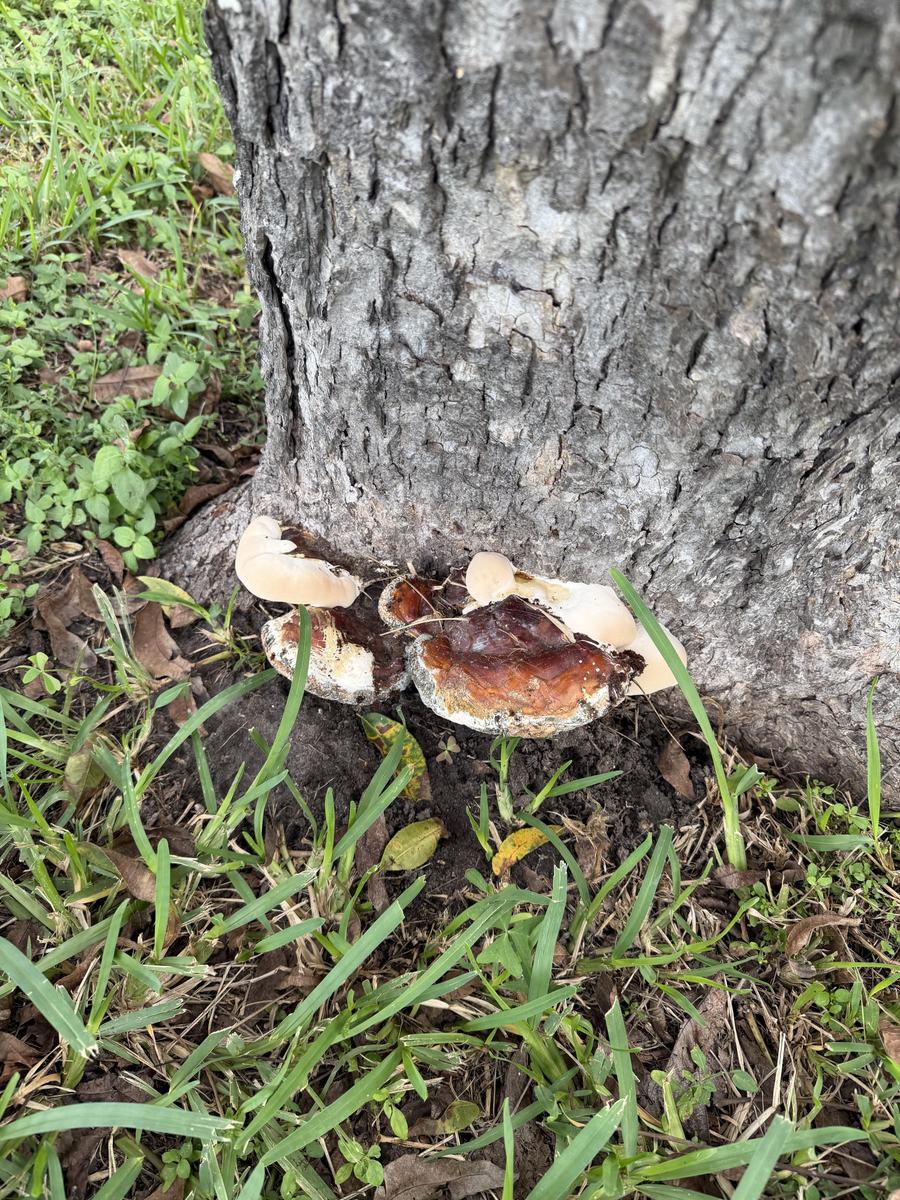
Varnished conks (Ganoderma). Hard, woody shelves at the base of the trunk, shiny red-brown on top with a white growing edge. Ganoderma and its relatives, such as the dull grey artist’s conk, decay the lower trunk and the big roots. A conk can last for years, adding a layer each season.
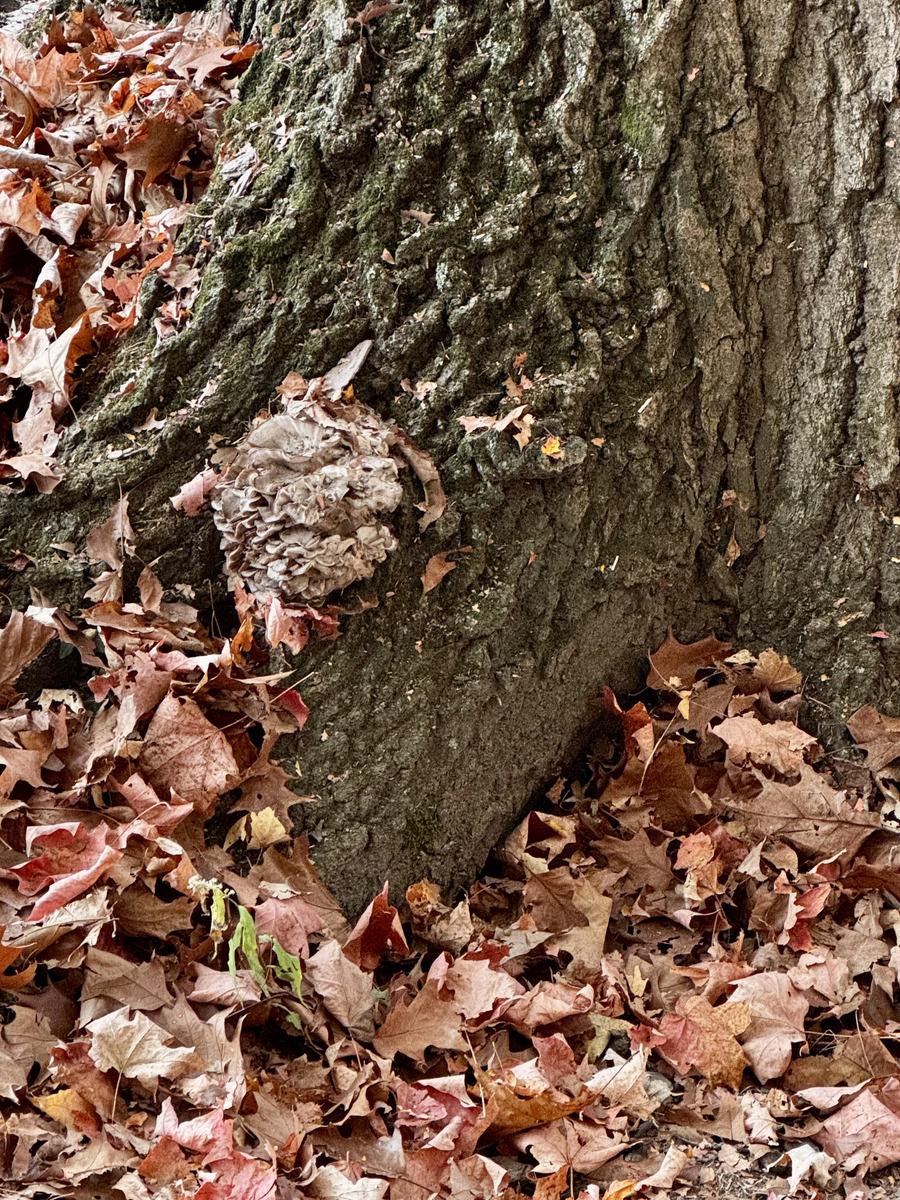
Hen of the woods. A big grey-brown rosette of overlapping frilly caps at the base of an oak. Prized by foragers, and also a sign of root and butt decay.
Chicken of the woods. Bright orange and yellow shelves, often on oaks, sometimes at the base and sometimes high on the trunk. It decays the heartwood and can leave a hollow trunk.
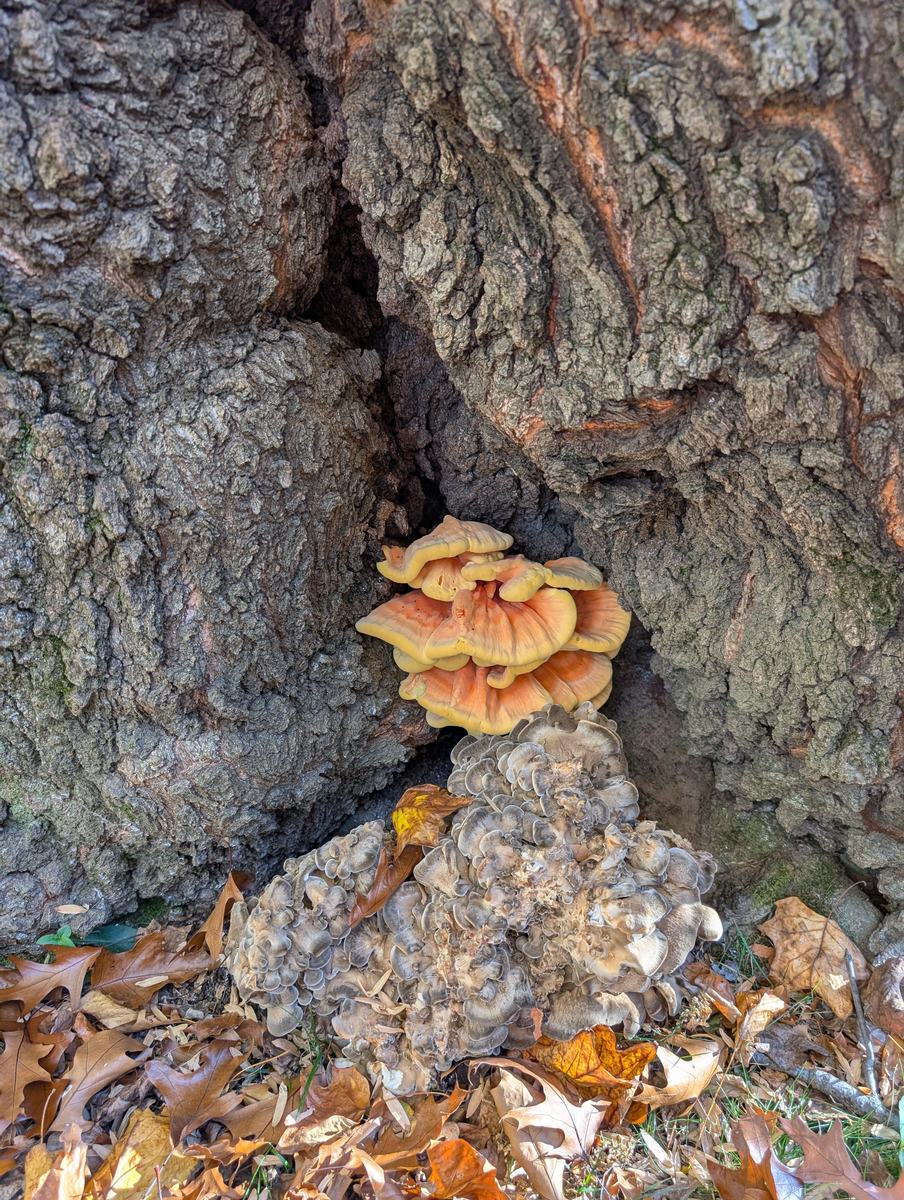
Giant polypores. Large clusters of overlapping brown caps at the base, often on oaks and beech, that can be bigger than a bushel basket. A sign of decay in the major roots.
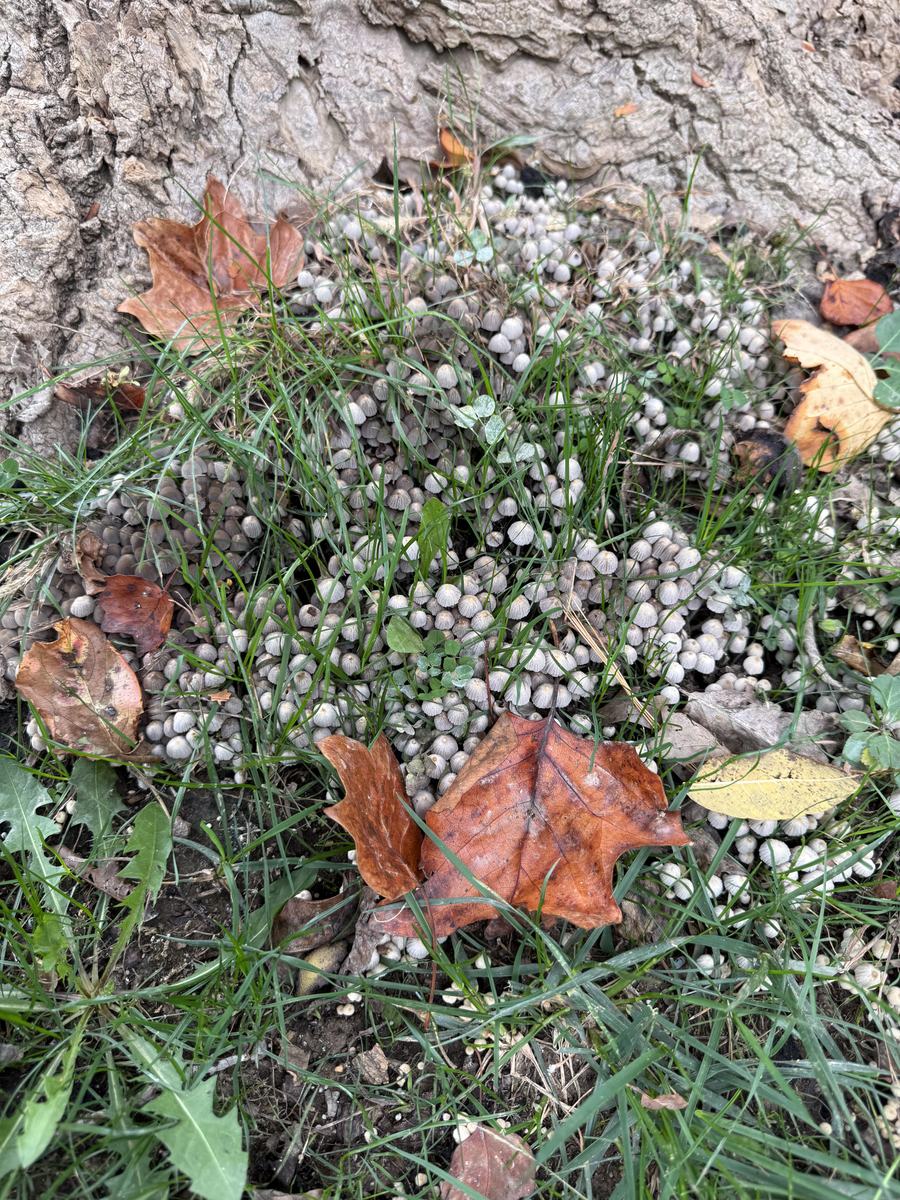
Fairy inkcaps. Hundreds of tiny grey bell-shaped caps packed together, often at the base of a tree or around an old stump, gone within a few days. They live on dead wood, so on their own they’re harmless. At the base of a living tree they’re telling you there’s dead wood under there, maybe an old root or a wound, and that’s worth a look.
Please don’t eat anything you find on a tree unless someone who really knows mushrooms has identified it in person. Several poisonous mushrooms look a lot like edible ones.
Does a mushroom mean the tree will fail?
Not by itself. Plenty of trees live for decades with decay inside them, because a tree only needs a shell of sound wood to stand. What matters is how much decay there is, where it is, and what’s underneath if the tree or a branch does fail. Sapwood infection, however, deserves it’s own article as often it is a clear indicator that a branch will fail since it is the sapwood that makes up for the majority of structural integrity.
When I’m assessing a tree with a fungus on it, I’m looking at more than the mushroom:
- How much sound wood is left. I’ll sound the trunk with a mallet, and on a tree where it matters, measure the decay with a resistance drill.
- The roots and soil. Cracked or lifted soil on one side, roots that have been cut by a trench or a driveway, or a lean that’s new.
- The rest of the tree. Thinning leaves, dead branches in the top of the crown, cracks and cavities.
- What’s in reach. A tree with root decay at the back of a field is a very different conversation from the same tree over a bedroom or a school bus stop.
Put together, that’s a tree risk assessment: how likely the tree or part of it is to fail, how likely it is to hit something, and how bad that would be.
What you can do, and what doesn’t help
Picking the mushrooms off doesn’t stop anything. The fungus is inside the wood or the soil. Removing the fruit is fine if you have kids or dogs who might eat them, but the decay carries on.
There’s no spray that cures wood decay. Fungicides don’t reach decay inside a trunk, and nothing reverses it once it’s there. Be wary of anyone who sells you a treatment for it.
Protect the roots you have. Keep heavy equipment, trenching and new paving away from the area under the canopy. Don’t pile mulch against the trunk; a few inches spread out to the dripline, kept off the bark, is plenty.
Keep an eye on it. Take a photo of the mushroom and the base of the tree each fall so you can see whether things are changing.
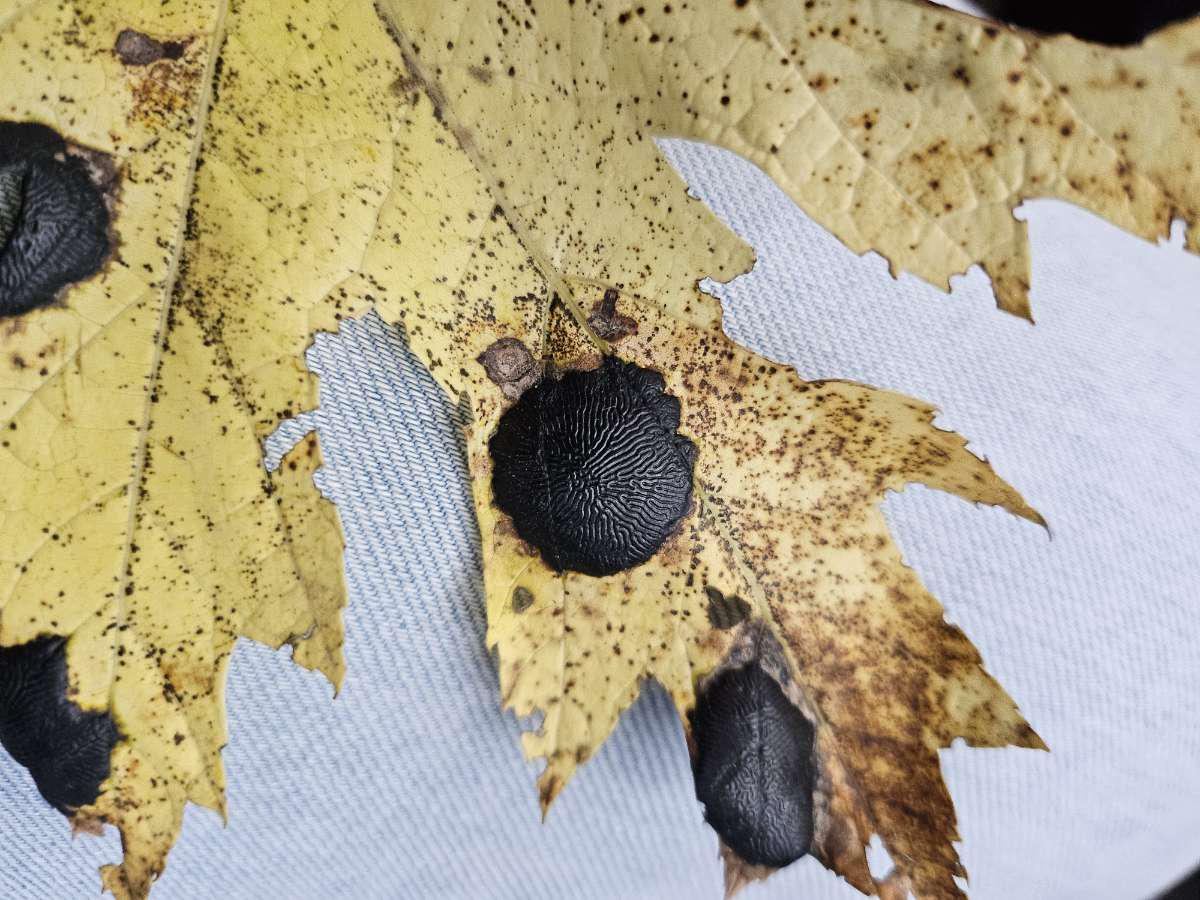
Not every fungus on a tree is a mushroom. If what you’re seeing is black spots on your maple’s leaves, that’s tar spot, a leaf fungus that looks far worse than it is. I wrote about it in What are the black spots on my maple leaves?.
When to call an arborist
Have the tree looked at by an ISA Certified Arborist if:
- mushrooms or conks are growing at the base, on the root flare or on the trunk of a large tree near your house, a driveway, a sidewalk or anywhere people spend time,
- the tree has started to lean, or the soil has cracked or heaved on one side,
- you see dead branches in the top of the tree, thinning leaves, or cracks in the trunk,
- the tree lost a big limb in a storm, or the roots were damaged by construction.
A good arborist will tell you what the fungus is likely to be, how much it matters for this tree in this spot, and what your options are, from “leave it and check it again next year” to pruning, cabling or removal. Sometimes the right answer is to do nothing at all, and you should hear that too.