Case Study: A Pin Oak That Wasn't Coming Back
A pin oak that dropped a big limb, with cankers on the trunk, dead side limbs and carpenter ants in the root flare. How I assessed it, and why it came down.
 By Adam O'Connor, ISA Certified Arborist
4 minutes read
On this page
At a glance
- Tree: Pin oak, Quercus palustris
- Size: About 25 inches DBH, 55 feet tall
- Setting: A yard on cleared land, with a gravel driveway and a pole barn, Northwest Ohio
- What’s in reach: Nothing serious. If the whole tree fell, it would barely reach a fairly busy road
- Overall risk rating: Low
- Recommended: Remove the tree, at the homeowner’s wish, since it was dying in their front yard
Why I was called
The landowner was concerned about all the dead growth along the trunk. They had recently lost a pretty big limb, and that brought it to their attention that there were other failures going on.
The site and what’s in reach
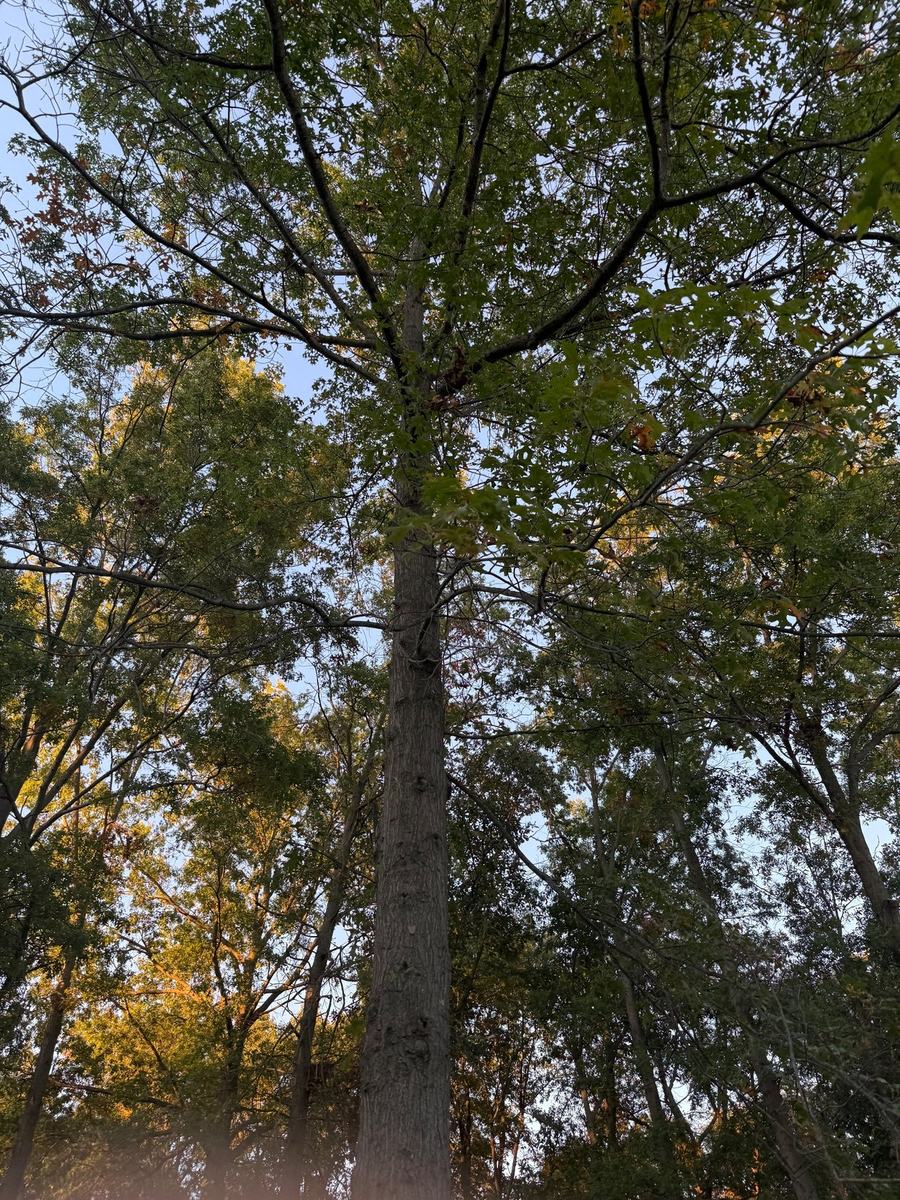
This oak grew up in a stand of trees, and the land around it was later cleared for a lawn. Now it stands on its own in the front yard, facing south. There weren’t any serious targets under it. If the whole tree came down it would barely make it to the road, but it’s kind of a busy road, so it could still have hit a passing car or someone walking by.
What I saw
I used a probe, a scope, a mallet and a tape measure to assess the tree.
It was pretty evident the tree was dying. There were cankers along the trunk, and most of the side limbs had died back.
My suspicion is that facing south, through a couple of drought summers, put the tree under too much stress, and it eventually started getting sunscald. A tree that grew up shaded among others has bark that isn’t used to full sun.
A closer look
At the root flare I was able to dig out some rot. In it I found quite a bit of insect frass, the sawdust-like debris insects leave behind, and the carpenter ants were pretty heavy. Carpenter ants don’t eat sound wood. They nest in wood that’s already decaying, so finding that many tells you how much rot is down there.
How I rated the risk
What worried me most was more limbs falling, and eventually the entire tree failing. I didn’t think it would go within a year, but I felt it was likely to fail within three.
Even so, I rated the overall risk Low, because there weren’t any serious targets of concern. The tree would only just reach the road, and a car or a walker would have to be passing at the wrong moment.
That’s the thing about a risk rating: it’s about what the tree could hit, not how healthy the tree is. A dying tree with nothing under it can still be Low risk.
What I recommended
It was pretty clear this tree was not coming back. The risk alone didn’t call for removal, so the decision came down to two things. The homeowner wanted it gone, and they’re the ultimate decision maker. And the tree was dying in a front yard.
Had it been on the edge of the property in the woods, we would have left it standing as habitat. In a front yard, that didn’t make sense.
What happened
We took it down the following weekend.
What this tree taught me
A big limb dropping is often the first sign the owner sees, but it’s rarely the first sign there was. A tree that grew up in the woods and is suddenly left in the open, facing south through drought, can decline fast. And a Low risk rating doesn’t mean a tree has to stay: where it stands, and what the owner wants, matter too.